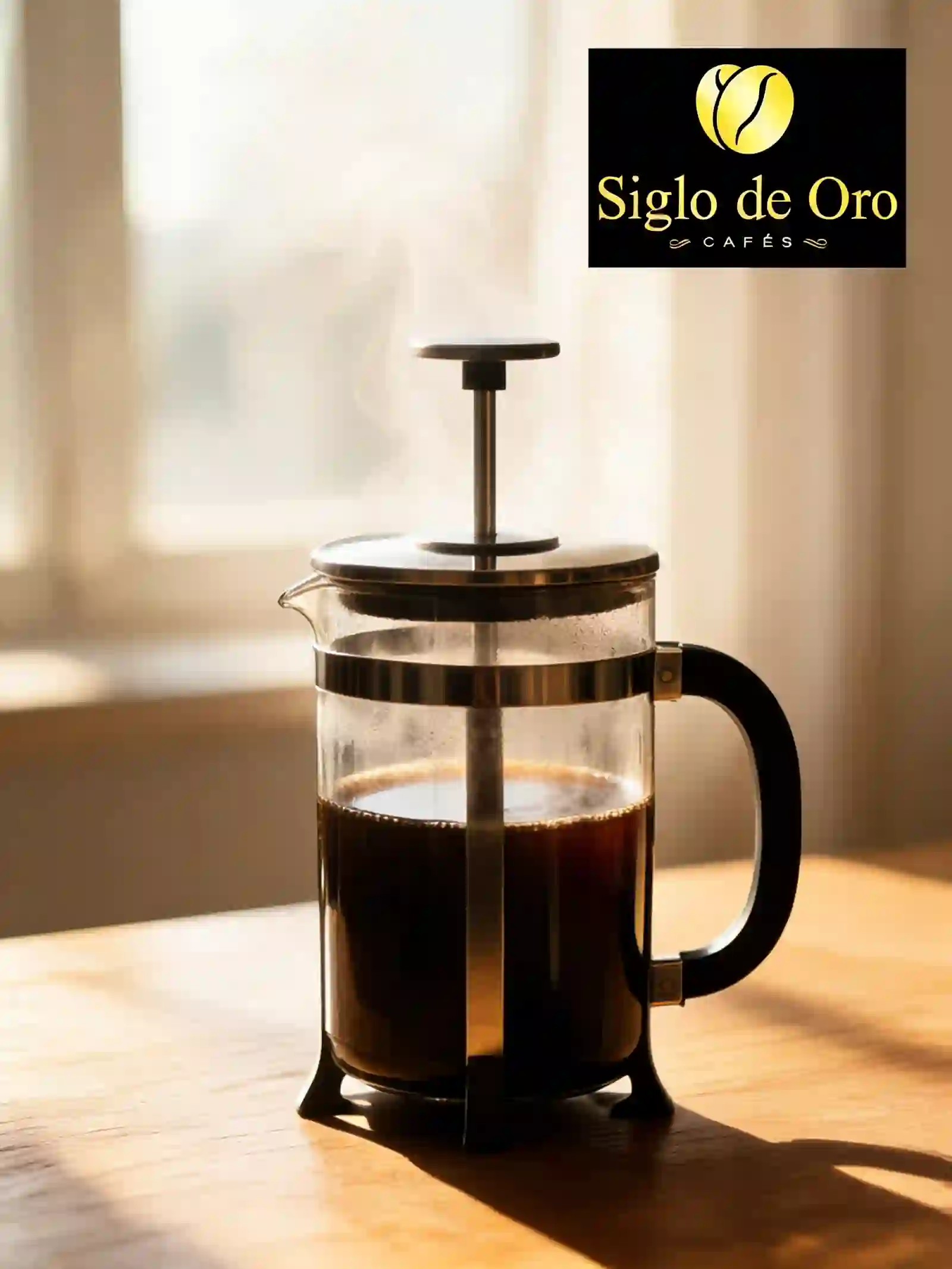
The French press has a reputation for bitter coffee full of sediment. It is nearly always down to two specific actions, and there is a technique that eliminates both: not pressing the plunger.
What makes it different
It's full immersion: the coffee is in contact with the water the whole time, and the filter is a metal mesh rather than paper. That mesh lets the coffee's oils through, along with some of the fine particles.
That's where its character comes from — dense body, an almost oily texture, a rounded flavour — and also its two typical faults: sediment in the bottom and a tendency towards bitterness.
The grind: coarse, and above all even
Sea salt texture. But the setting isn't the point: what's decisive is that there are few fines.
Fines are coffee dust that over-extracts within seconds and that the mesh doesn't retain. They're responsible for the bitterness and for the silt at the bottom. A blade grinder generates fines by design, which is why many people believe French press coffee tastes bad when what they actually have is the wrong grinder.
Base recipe
- Coffee: 30 g per 500 g of water (a 1:16 ratio).
- Water: 93-95 °C. Boil and wait half a minute.
- Pour all the water at once and start the timer.
- At four minutes, break the crust that's formed on top by stirring three or four times with a spoon.
- Skim off the foam and any floating grounds with two spoons. A good deal of the bitterness concentrates there.
And from here, the part that changes the result.
The no-plunge technique
Pressing the plunger does two unhelpful things: it agitates the coffee bed just as it's finished extracting, and it pushes fines into the liquid you're about to serve.
The alternative, popularised by James Hoffmann, is simple: after skimming, leave the press completely still for 5 to 8 minutes. The grounds sink under their own weight. Then rest the plunger on the surface without pushing, purely to hold back the floating layer, and pour slowly without draining the last inch.
It takes twice as long and gives a noticeably cleaner, less bitter cup. If the French press has never convinced you, try this before writing it off.
Why it turns out bitter
Three causes, in order of frequency:
- A grind with too many fines. The most common by a distance.
- Leaving it standing after pouring the first cup. The coffee is still in contact with the water and still extracting. Decant the rest into another vessel or a flask.
- Boiling water. At 100 °C you dissolve compounds that at 93 °C stay where they are.
Getting rid of the sediment
Besides not plunging: let it settle longer before serving, don't drain the bottom of the jug, and if it really bothers you, pass the coffee through a paper filter as you serve. You lose some of the body, which is precisely what you came for, so it's a trade worth weighing.
Advantages it doesn't get credit for
It's among the cheapest methods there is — a decent press costs €20 and uses no filters — it has no electronics to fail, and it's forgiving: five seconds either way doesn't ruin the cup as it would with espresso.
And for more than two people it's more practical than any pour-over: you make a litre in one go instead of spending half an hour serving cups.
Which coffee to use
Immersion favours coffees with body, where chocolate, nuts and caramel take the lead. The Especial Bouquet fits well.
With a more acidic single origin like the Colombia, drop the water to around 91 °C and shorten to three and a half minutes: it comes out more aromatic and less heavy.
If you want a cleaner, more defined cup, the natural next step is the V60. If you want something that fits in a rucksack, the AeroPress. Buy whole bean and grind coarse — it's in the shop.