
The pattern is the consequence, not the goal: if the milk is textured properly the heart almost pours itself. Including the part nobody mentions — which machines make it flatly impossible.
The pattern is the consequence
You don't learn latte art by practising the pattern. You learn it by texturing milk properly. Get real microfoam and the heart will more or less pour itself within a few weeks; fail to get it and you can practise for a year without success.
So nearly everything that follows is about milk.
First: check your steam wand
This saves months of frustration. There are two kinds:
- Open wand — a metal tube with one or more holes. This is the one that lets you texture properly, because you control how much air goes in.
- Panarello or assisted wand — it has a plastic sleeve with a side hole that draws in air automatically. It generates abundant, large-bubbled foam, more like bath foam. You cannot do latte art with this.
If your machine has a panarello, the sleeve can often be pulled off to reveal a normal wand underneath. Worth checking before writing the whole thing off.
How texturing works
It's two consecutive phases, not one:
1 · Introducing air (5-8 seconds). With cold milk and the tip just under the surface, open the steam. It should sound like paper tearing gently, in short ticks. If it sounds like loud gargling you're adding too much air and you'll get large bubbles. Here you increase the milk volume by 20-30 %, no more.
2 · The whirlpool (the rest). Sink the tip a little deeper and angle the jug so the milk spins in a vortex. No more air goes in: what you're doing is breaking up the large bubbles and distributing them until the milk looks like liquid paint. This phase creates the microfoam.
When you finish, tap the jug on the counter to burst any remaining bubbles and swirl it until it shines.
The right temperature: 60-65 °C
Without a thermometer: stop when you can no longer hold your hand on the side of the jug for more than two or three seconds.
Below 55 °C the coffee comes out lukewarm. Above 70 °C the milk proteins denature, the foam collapses and you get that scalded-milk flavour that spoils the drink. Lactose is also perceived as sweetest right in that band: properly steamed milk tastes sweet without adding sugar.
Which milk
Whole, cold, straight from the fridge. Fat gives silky texture and flavour; skimmed foams more but drier and with less body, and tastes of less.
Among plant drinks, "barista" oat versions behave far better than the rest: they contain stabilisers and added protein for exactly this purpose. Almond and rice split readily on contact with the acid in coffee.
The trick for practising without wasting milk
A barista training classic: fill the jug with water and a drop of washing-up liquid. The texture and behaviour are surprisingly close to milk, and you can repeat the movement twenty times over without throwing money away or ending up drinking five milky coffees.
Practise the pour alone. Once the motion is automatic, move to real milk.
The heart, step by step
- Pour the espresso into a wide, shallow cup. Tall narrow cups make it much harder.
- Start pouring from about 8-10 cm up, in a thin stream, into the centre. The milk sinks under the crema and nothing appears yet.
- When the cup is two-thirds full, drop the jug until it's almost touching the coffee and pour faster. That's when the foam surfaces and the white circle appears.
- To finish, lift the jug and cut through the circle by drawing towards yourself.
The near-universal error is not dropping the jug. From height, the milk always sinks and never draws.
The espresso underneath counts too
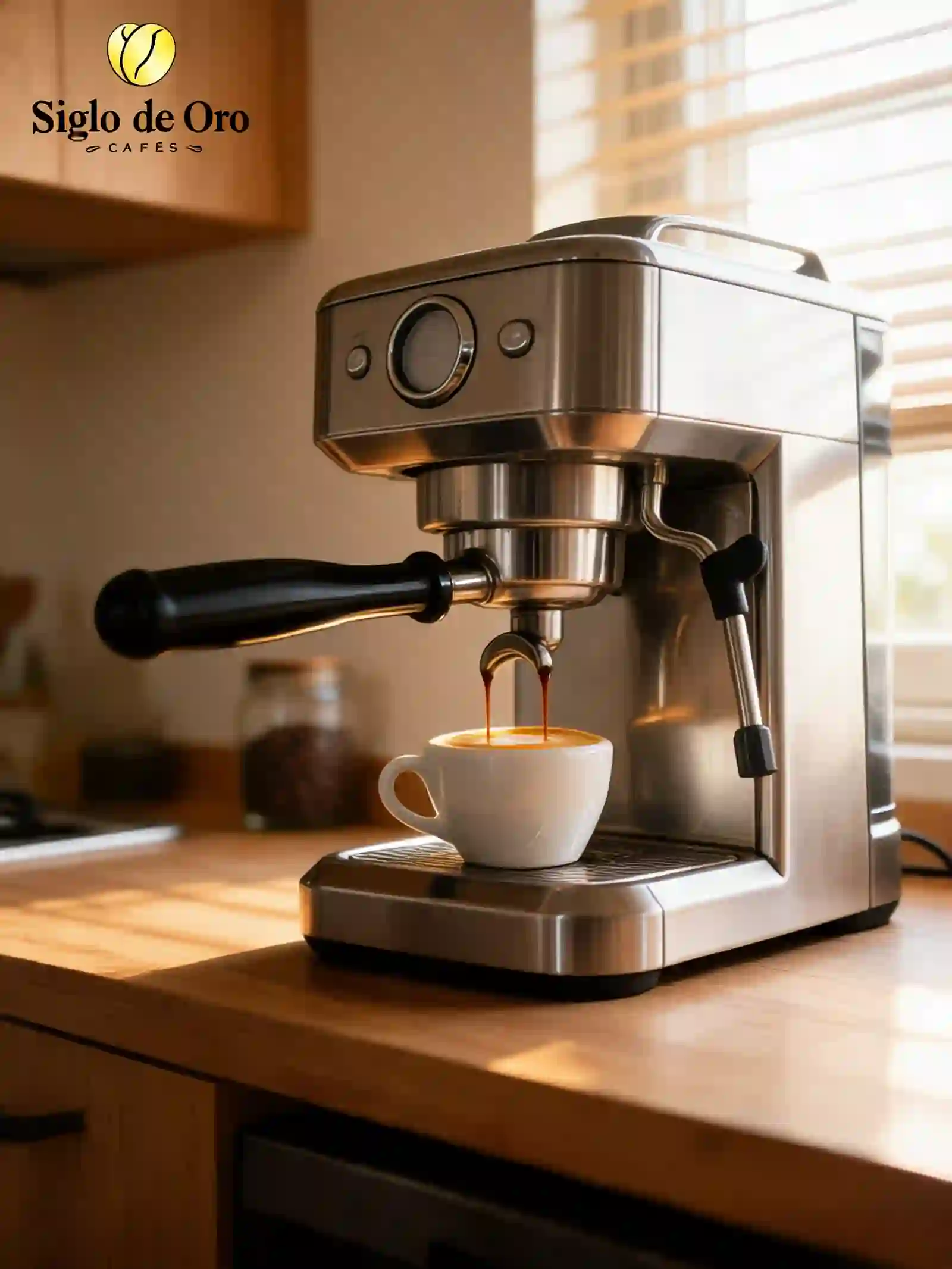
If the crema is thin or disappears quickly, there's no canvas to draw on. A well-extracted espresso with fresh coffee gives a dense, hazelnut-coloured crema that holds. How to get there is in the home espresso guide, including the pressurised basket problem, which also ruins crema.
For milk drinks, medium and medium-dark roasts work better, with enough body not to vanish under the dairy: our Especial Bouquet sits in that range. If you're still choosing a machine, see how to choose a coffee maker. Coffee is in the shop.