Three mountain ranges, two harvests a year and half a million families farming plots of a hectare and a half. Why Colombia produces what it does, what changes between Huila and Nariño, and the argument the country is still having.
Three mountain ranges, not one
The Andes enter Colombia and split into three parallel ranges running south to north. Deep valleys sit between them, and coffee grows on the slopes of all three.
That geography explains almost everything else. A relatively compact country ends up with dozens of distinct microclimates, differing in aspect, altitude and rainfall within a few kilometres of one another. Which is why a coffee from Nariño and one from Antioquia can taste like they come from different countries.
Add proximity to the equator — which gives stable temperatures year round — and volcanic soils, and you have exactly what arabica asks for.
Two harvests a year
A Colombian peculiarity worth knowing, because it affects what you buy.
Most coffee-producing countries have one annual harvest. Colombia has two: the main crop and the mitaca or fly crop, smaller, roughly six months later. And because the regions don't share a calendar, coffee is being picked somewhere in Colombia in practically every month of the year.
For a buyer, that means a better chance of finding fresh-crop Colombian coffee at any point in the year — something that isn't true of single-harvest origins.
Half a million smallholdings
Colombia isn't a country of large estates. Production sits with around 500,000 families, on an average holding of roughly two hectares.
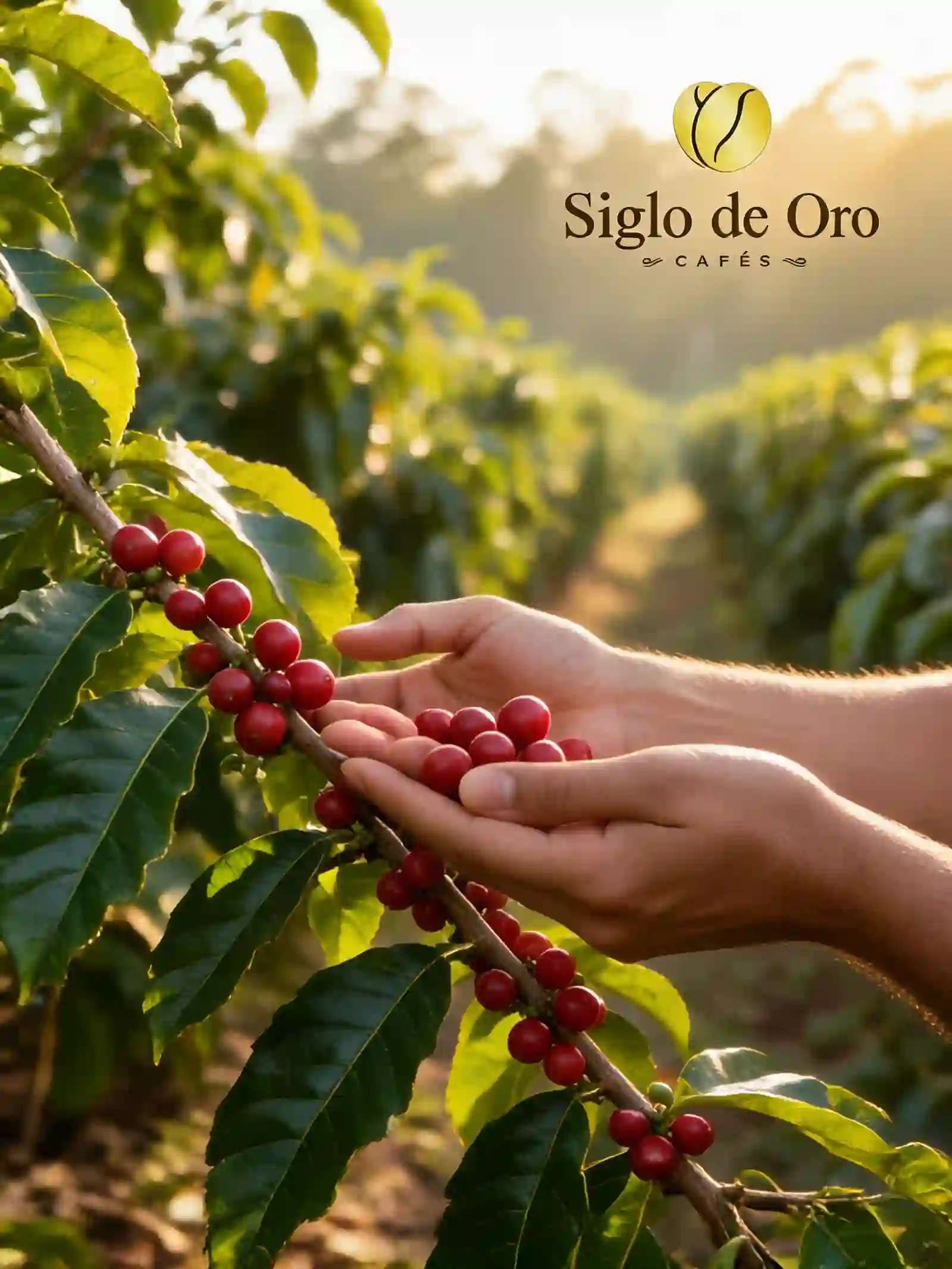
That has concrete consequences. Picking is done by hand and in passes — you cannot mechanise a slope that steep — which allows only ripe cherry to be taken, and that is the foundation of quality. It also means there are many producers behind every sack, and traceability depends on how the cooperative assembling the lot works.
What each region contributes
| Region | Typical profile |
|---|---|
| Huila | Bright acidity, red fruit, plenty of structure |
| Nariño | Very high altitude, floral, complex and delicate |
| Cauca | Citrus, marked acidity, clean cup |
| Tolima | Sweet, stone fruit, medium body |
| Coffee Axis | Balance and consistency, caramel and nuts |
| Antioquia | Body, cocoa, a more classic profile |
These are tendencies rather than rules: within each region there's enormous variation by farm, altitude and process.
Almost entirely washed
Colombia is washed-coffee country: the cherry is depulped, fermented to remove the mucilage and washed before drying. The result is a clean cup with defined acidity and the origin clearly on show.
There's a practical reason as well as tradition: in a humid climate, drying whole cherry in the sun — the natural process — is risky, because uneven drying spoils the lot. Even so, more producers are experimenting with naturals and honeys, which give sweeter, fruitier cups. The differences are in the tasting notes guide.
The open argument: Caturra or Castillo
This is the live conversation in Colombian coffee, and it explains a good deal of what's in your cup today.
Leaf rust, a fungus that devastated plantations from 2008 onwards, forced much of the country to replant. The National Federation of Coffee Growers promoted the Castillo variety, bred to resist it.
Agronomically it worked: it saved the crop. But it opened a debate that hasn't closed. Part of the sector maintains that Castillo doesn't reach the cup quality of traditional Caturra. Others reply that grown and processed well it produces excellent results, and that the comparison is usually made between an ordinary Castillo and a hand-picked Caturra.
Without resistant varieties there wouldn't be enough Colombian coffee at all. The argument isn't whether they were needed, but how much cup quality was accepted as the price.
The background is in the varieties guide and in the article on the future of coffee under climate change.
Our Colombia
We look for the profile that best represents the origin: lively but balanced acidity, notes of caramel and red fruit, and a clean citrus finish.
It works particularly well as filter, where that acidity has room to express itself — the V60 guide is a good place to start — and also as a brighter espresso for anyone not after the traditional dark profile. It's in the shop, whole bean or ground, and if that's the profile you're after there's more on fruity coffee.