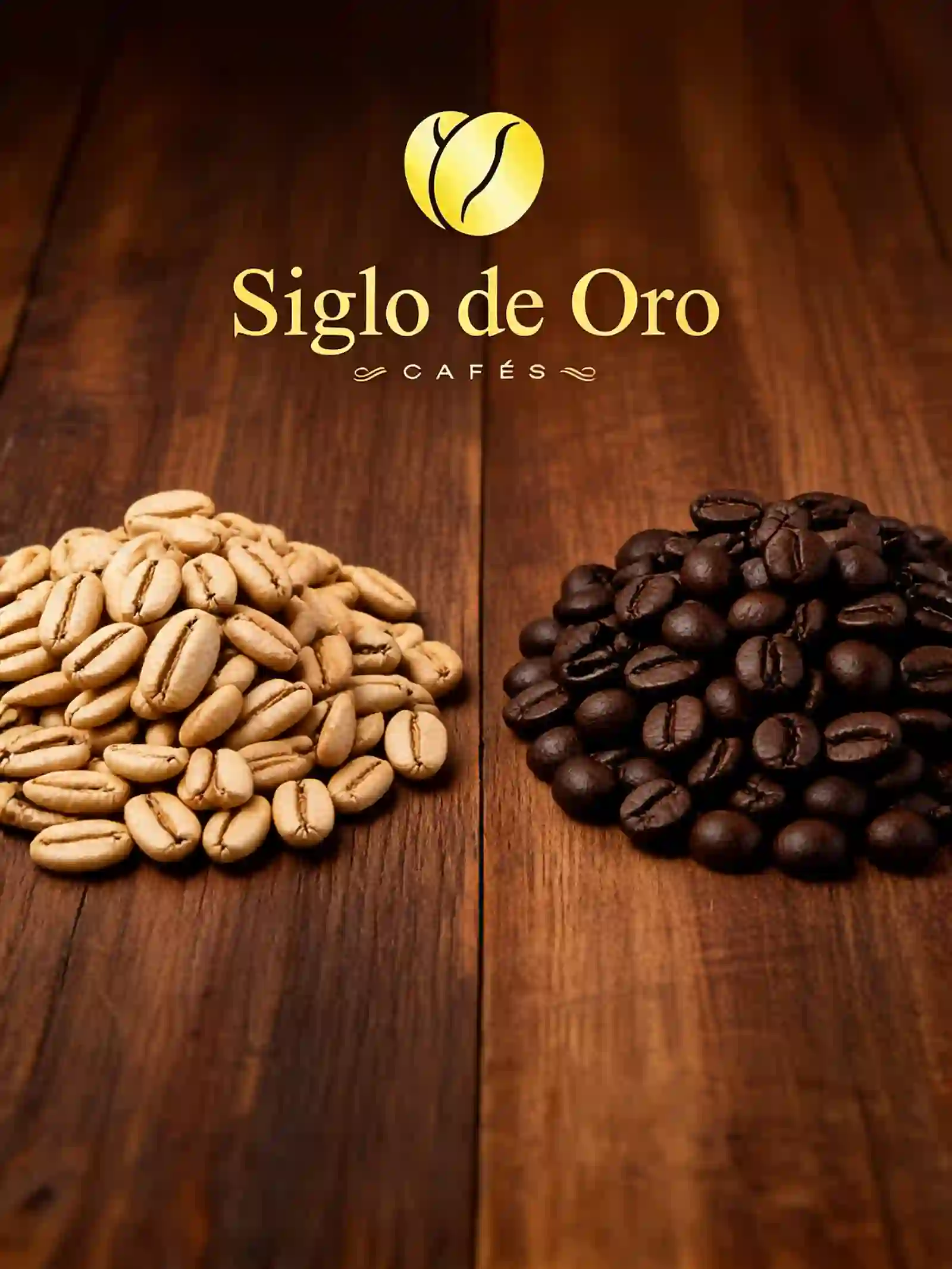
Arabica dominates specialty coffee and robusta carries a bad reputation. The reality has more nuance: what genuinely separates the two species, and why your local bar espresso tastes the way it does.
Where each one comes from
Practically all the coffee traded in the world belongs to two species: Coffea arabica and Coffea canephora, the latter known commercially as robusta. The split runs at roughly 60/40 in arabica's favour, though robusta has been gaining share for years.
There's a detail that almost never gets mentioned and that changes how you see the whole thing: arabica is not an "original" species. It's a natural hybrid that appeared millennia ago in what is now South Sudan, from a cross between Coffea canephora and Coffea eugenioides. In other words, robusta is one of arabica's two parents. Which is why they share so much and why they can be crossed in breeding programmes.
What differs in the plant
| Arabica | Robusta | |
|---|---|---|
| Typical altitude | 900-2,000 m | 0-800 m |
| Caffeine | 1.2-1.5 % | 2.2-2.7 % |
| Chlorogenic acids | 5-7 % | 7-10 % |
| Lipids and sugars | High | Low |
| Rust resistance | Very low | High |
That table explains nearly everything else. Arabica needs altitude and cool nights, ripens slowly and accumulates sugars. Robusta tolerates heat, humidity and pests that kill arabica, yields more per hectare and is considerably cheaper to grow.
Why arabica tastes better
It isn't about prestige, it's chemistry. The sugars and lipids in green coffee are the raw material for the Maillard reactions that happen during roasting, and that is where aromatic compounds come from. More sugar and more fat simply means more material to work with: sweetness, fruit acidity, floral notes, a silky body.
Chlorogenic acids pull the other way. During roasting they break down into lactones and phenolic acids, responsible for much of the bitterness and astringency. Robusta has considerably more, and you notice it in the cup as that dry, rasping edge on the tongue.
If you want to go deeper into which compounds produce which aromas, we cover it in the tasting notes guide.
Robusta's problem isn't robusta
This is where it pays to be honest, because the usual specialty coffee line overshoots.
Robusta's poor reputation comes from the fact that the overwhelming majority of it is grown for volume and price rather than for the cup: mechanical stripping without selection, careless processing, uneven drying, very dark roasting to mask defects. Start from there and any coffee tastes bad. Arabica treated the same way does too.
The species sets the ceiling for aromatic complexity. What decides whether a coffee is good or bad is how it's grown, processed and roasted.
There is in fact a formal fine robusta category, with its own scoring protocol, and well-handled robustas comfortably outperform plenty of commercial arabicas. They're a minority, but they exist.
That said, the ceiling isn't the same. Excellent robustas tend to stand out for body, chocolate and nuts; rarely for the bright acidity and floral complexity of the best high-grown arabicas. Which is why specialty coffee works almost exclusively with arabica — not because robusta is beneath consideration, but because the range of aromatic expression is narrower.
Why your bar espresso contains robusta
If you've noticed that espresso in a traditional Italian café has a thick, persistent crema you can't reproduce at home, part of the explanation is robusta. The Neapolitan tradition blends in between 10 % and 30 % of it, and not to cut costs: it adds body, a far more stable crema and the bitter "kick" that's deliberately sought there.
In Spain there's an additional factor worth knowing about, because it affects nearly all supermarket coffee: torrefacto. It's a roasting method in which sugar is added — up to 15 % of the weight of the green coffee — which caramelises and coats the bean. It was invented as a preservation method in an era before vacuum packing, and stuck around out of habit. It brings dark colour, bitterness and a burnt aftertaste, and usually accompanies cheap robusta.
When a Spanish pack says "mezcla", it almost always means a blend of natural and torrefacto coffee, not a blend of origins. If you're buying coffee in Spain, that's the single most useful thing you can learn to read on a label.
How to tell what you're drinking
- "100% arábica" — the species is clear, but it says nothing about quality. There is dreadful arabica.
- "Natural" — roasted with no added sugar. This is what you want.
- "Torrefacto" or "mezcla" — contains burnt sugar. For "mezcla", the label must state the proportion.
- Roast date — if there's only a best-before date, that's a bad sign. The date that matters is when it was roasted.
- A specific origin — farm, region or cooperative. If it only names the country, or not even that, there's no traceability behind it.
Which to choose
If you want to explore flavours, notice differences between origins and drink coffee slowly, specialty arabica without hesitation. That's where all the complexity lives.
If you're after a full-bodied espresso with dense crema in the Italian style, a blend containing some good robusta makes perfect sense and is no heresy at all.
If caffeine is your concern, robusta gives you close to double per cup. We cover it in more detail in the article on caffeine.
And one point that will carry more weight in the coming years: robusta handles heat far better than arabica, which puts it at the centre of the debate on the future of coffee under climate change. A good deal of current agronomic research is heading in exactly that direction.
At Café Siglo de Oro we work with specialty arabica, roasted in small batches. If what you want is a cup without bitterness, we cover it in smooth coffee. You can see the full range in the shop, and if you want to understand what sits behind the word "specialty", start with this article.